
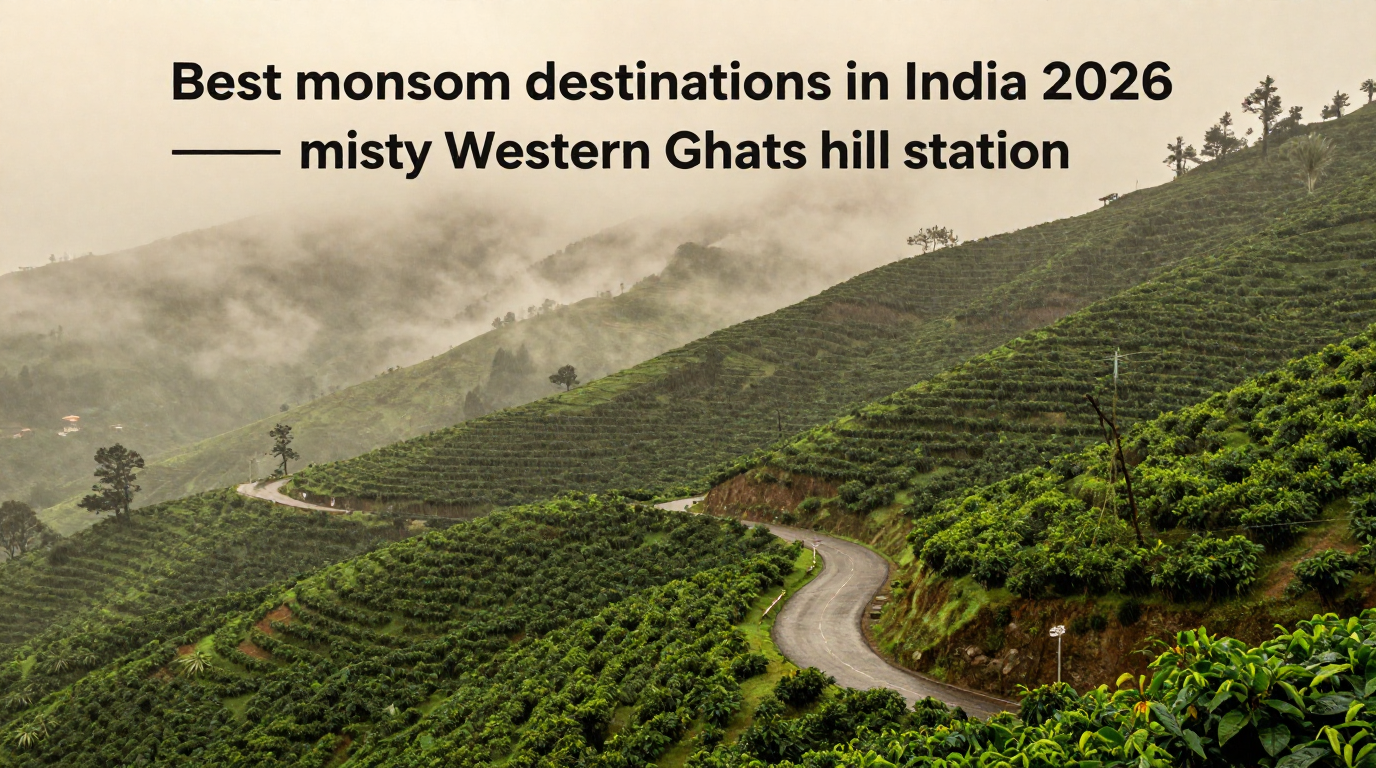
Most people quietly shelve their travel plans the moment the monsoon forecast shows up on the news. That's exactly the mistake seasoned travellers don't make. India's 2026 monsoon arrived in Kerala on May 24 — the earliest start in over a decade — and it's already reshaping the travel calendar: airfares are dropping, hotel rates are softening, and several of the country's most photogenic landscapes are at their absolute best right now.
This guide breaks the season down by region, tells you honestly where the rain helps and where it doesn't, and shows you exactly how to book each kind of trip — flight, hotel, bus, or full holiday package — without getting caught out by a landslide-closed road or a flooded itinerary.
A few reasons this season works in your favour rather than against you:
The trick is simply knowing which destinations to chase and which to avoid this time of year — which is exactly what the next section covers.
These destinations don't just survive the rain — they're built for it.
Best way to book: these routes are well-served by direct flights into Cochin, Mangalore, Mysore, or Pune, paired with a hotel or homestay package. A bundled holiday package usually works out cheaper than booking flights and stays separately.
If you'd rather skip the rain altogether, head north and up. Ladakh and Spiti Valley sit in the rain shadow of the Himalayas, meaning the monsoon clouds simply don't make it over the mountains.
Best way to book: flights into Leh from Delhi connect well this season, and a multi-day road itinerary (Leh–Nubra–Pangong) is best arranged as a package with a local vehicle included, since public transport options are limited at this altitude.
Not everyone can take a long trip — and you don't need one.
Best way to book: for distances under 300-400 km, a bus or self-drive option is often more practical than flying — road trips also let you stop at viewpoints along the way that flights obviously can't offer.
Rajasthan isn't the first place people associate with monsoon travel, but it has a genuine seasonal moment.
Best way to book: these are well-suited to a short flight plus a 2-3 night hotel stay, ideal for a long-weekend cultural trip rather than a full vacation.
Search interest in Northeast India travel has grown sharply this year, and the monsoon season is part of the reason.
Best way to book: flights connect well into Guwahati, from where road transfers reach most of these destinations within a few hours — a package that bundles flights, local transfers, and stay is the simplest way to plan this one.
A few practical notes before you lock in dates:
Once you've picked a region, the booking itself shouldn't be the hard part:
If you're not sure where to go, our team can compare a few region options side by side based on your budget, dates, and how much rain you're actually comfortable with.
Explore Holiday Packages | Book Flights | Check Bus Routes | Talk to Our Team
Is Goa good to visit during monsoon? Yes, if you want a quieter, greener version of Goa at a fraction of peak-season prices. Beach shacks and water sports mostly shut down, but inland waterfalls, spice plantations, and heritage churches are at their best, and the Sao Joao festival in late June is a genuine monsoon highlight.
Is Ladakh open during June and July? Yes — Ladakh is one of the best monsoon-season destinations precisely because it sits in a rain shadow. Roads typically open by late May, and the region stays dry and accessible right through summer.
What is the best month to visit India during monsoon? September tends to offer the best balance: the heaviest rains have usually passed, the greenery is still at its peak, prices remain low, and most destinations are fully accessible again.
How much do domestic flights drop during monsoon season? Fares on many popular leisure routes fall by roughly 30-50% compared to peak winter pricing, with midweek departures offering additional savings.
What are the best monsoon destinations for couples? Munnar, Alleppey, Coorg, and Kodaikanal are consistently popular for monsoon couple getaways, while Wayanad and Meghalaya are good picks for couples wanting something more offbeat.

 Safe Payments. Confirmed Bookings. Your payment security matters. Our booking system is encrypted and reliable, and confirmations are processed quickly. No confusing steps, no risky transactions. Just a smooth and secure booking experience from start to finish.
 No Hidden Charges. No Last-Minute Surprises. What you see is what you pay. We don’t play pricing games or sneak in extra charges at checkout. Every fare is shown clearly with baggage details and fare rules upfront. You shouldn’t need a magnifying glass to understand your ticket cost.